


What are the WFEB International Football Skills Tests and how do they work?
If you have ever tried to explain a player’s ability using phrases like “good touch” and “quick feet”, you already know the problem. It is subjective.
One coach says “top player”, another says “needs work”. The WFEB International Football Skills Tests exist to bring a bit of structure to that conversation.
Not to label players, but to give them a fair snapshot of where they are today and a clear way to show progress over time.

Quick answer, what is WFEB?
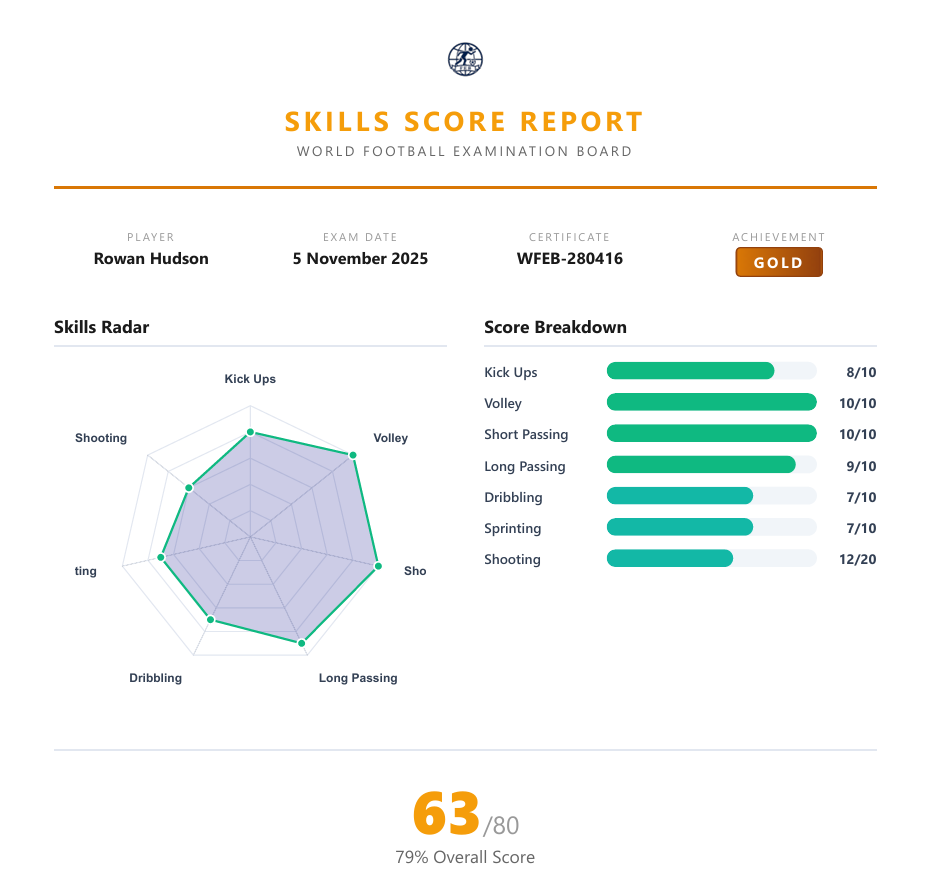
The WFEB International Football Skills Tests are structured football skills assessments that players do in person with a coach or teacher. A player completes a set of challenges, receives a final score out of 80, and earns a certificate based on that score. The result is saved on the WFEB database so it can be checked later by clubs, schools,
scouts, players or parents.
You can think of it like a standardised test/assessment/exam, but for football skills. You get something measurable you can talk about, not just a vibe and a handshake.
You will appreciate that, we like things straight and clear.
Useful internal links
- The skills exam, what is included and what the scores mean
- Organising exams, how coaches and clubs run exam days
- Check a certificate, confirm a result quickly
- Shop, exam guide
Who is this for?
Players and parents
- Get a clear snapshot of ability today, not just opinions.
- Track progress across the season, especially if a player retakes the exam later.
- Share a certificate when joining a new team, academy trials, school football, or just for personal pride.
Coaches and teachers
- Run an exam day using a consistent structure, the same scoring rules each time.
- Enter scores online, the system totals the points and generates the certificate.
- Use credits to run multiple exams, with results saved on the database.
Clubs and scouts
- Check if a certificate matches the official WFEB database record.
- Confirm results quickly when a player applies for a team or trial.
- Reduce the “he said, she said” that can happen around scores and claims.

How the exam works, step by step
WFEB keeps the process simple. Players do the exam in person, a coach records scores, then the result becomes a certificate and a database record.
Here’s the basic flow.
- A coach or teacher sets up an exam day. This can be at a club, school, academy, or organised session.
- The player completes the challenges. The exam covers core areas like passing, shooting, touch, dribbling and speed.
- The coach enters the scores online. The system calculates the totals automatically.
- The certificate is generated. The player receives a PDF certificate and a saved record.
- Results can be checked later. Clubs, schools, scouts, players or parents can verify when needed.
If you want the short version, it is: do the exam, get the score, get the certificate, save it on the database. No drama, no guesswork, no “my mate said i’m definitely Championship level”.
If you are a coach, you can read the organiser view here: Organising Exams.
If you are a player or parent, start here: The Skills Test.
What does a score out of 80 actually mean?
A score out of 80 gives you a single headline number that is easy to understand. It also gives you a consistent way to compare a player to themselves over time.
That is the key point, improvement over time usually matters more than a single score on a random Wednesday.
The exam breaks down football skills into measurable tasks. You can use the breakdown to spot strengths and set targets for training.
That idea, measure, practise, measure again, shows up in a lot of modern player development thinking, including FIFA’s work around structured talent pathways.
If you like reading the official stuff, FIFA’s training centre has good resources on youth development.
FIFA training centre: talent development
The FA also talks about helping young players develop technical skills over time, using repeat practice and good coaching habits.
The FA: developing technical players
Why coaches like it
Coaches are busy. They do not want admin for the sake of admin. They want a system that helps them run a good session and gives players something meaningful at the end.
WFEB helps because it:
- Creates a repeatable exam day format. Same structure, same scoring approach, less confusion.
- Turns scores into certificates automatically. No manual certificate design every time.
- Stores results in one place. So players can reference them later and clubs can verify if needed.
- Supports retakes. If a player improves, that improvement becomes part of their story.
If you run a club or a school programme, repeatable exams can also become a steady income stream for organisers, especially if you run them at regular intervals.
You can read more about the organiser side here: Organising Exams.

Why parents and players like it?
Parents usually want three things. They want their child to enjoy football, improve steadily, and get fair opportunities. Players want to feel progress and feel proud of it.
A certificate can help because it:
- Makes progress visible. It is easier to stay motivated when you can see improvement.
- Gives a clear target. Players often train harder when they have something specific to aim for.
- Helps conversations with coaches. It is easier to plan training when you have a clear baseline.
If you have ever tried to get a teenager to practise volley-touch in the garden, you will know why targets help. Without a target, it is “later”. Later never comes.
Want to see what the exam includes? Start here: The Skills Exam.

How certificate checking works
Clubs and scouts need quick clarity. If a player brings a certificate, they want to confirm it matches the official database record.
That is where verification helps, it keeps things clean and avoids confusion.
The certificate check process is simple:
- Open the check page
- Enter the details needed for a match
- Get a clear result
You can try it here: Check a Certificate.
Privacy and children’s data
Because football includes a lot of young players, data handling needs to be taken seriously. That means clear language, careful permissions, and sensible defaults.
You can read the ICO guidance on children and data protection here:
ICO: children and the UK GDPR.
If your service is likely to be accessed by under 18s, the UK also has an Age Appropriate Design Code.
ICO: Age Appropriate Design Code.
In simple terms, keep it clear, keep it fair, and do not collect more personal data than you actually need to run the service properly. That approach also tends to make websites better for everyone, adults included.
How to get started
Where you start depends on who you are.
Choose your route
- Players and parents: Read the skills exam, then ask your coach or club about running an exam day.
- Coaches and teachers: Read organising exams, then register and set up your first exam day.
- Clubs and scouts: Use check a certificate when you need to confirm a result quickly.
If you want to purchase the exam guide, head to the shop:
WFEB shop.
One last thing, this is about progress, not judgement
A score is only useful if it leads to the right next step. Use it to set targets and to track improvement, not to put kids and adult players in boxes.
Football careers develop over time, and sometimes the best player in Year 6 is not the best player at 16. Anyone who has watched grassroots football will have seen that happen plenty of times.
If you want a starting point, read the skills exam and then decide when you want to run your first exam day.
If you have questions, use the contact page on the site and someone will point you in the right direction.